

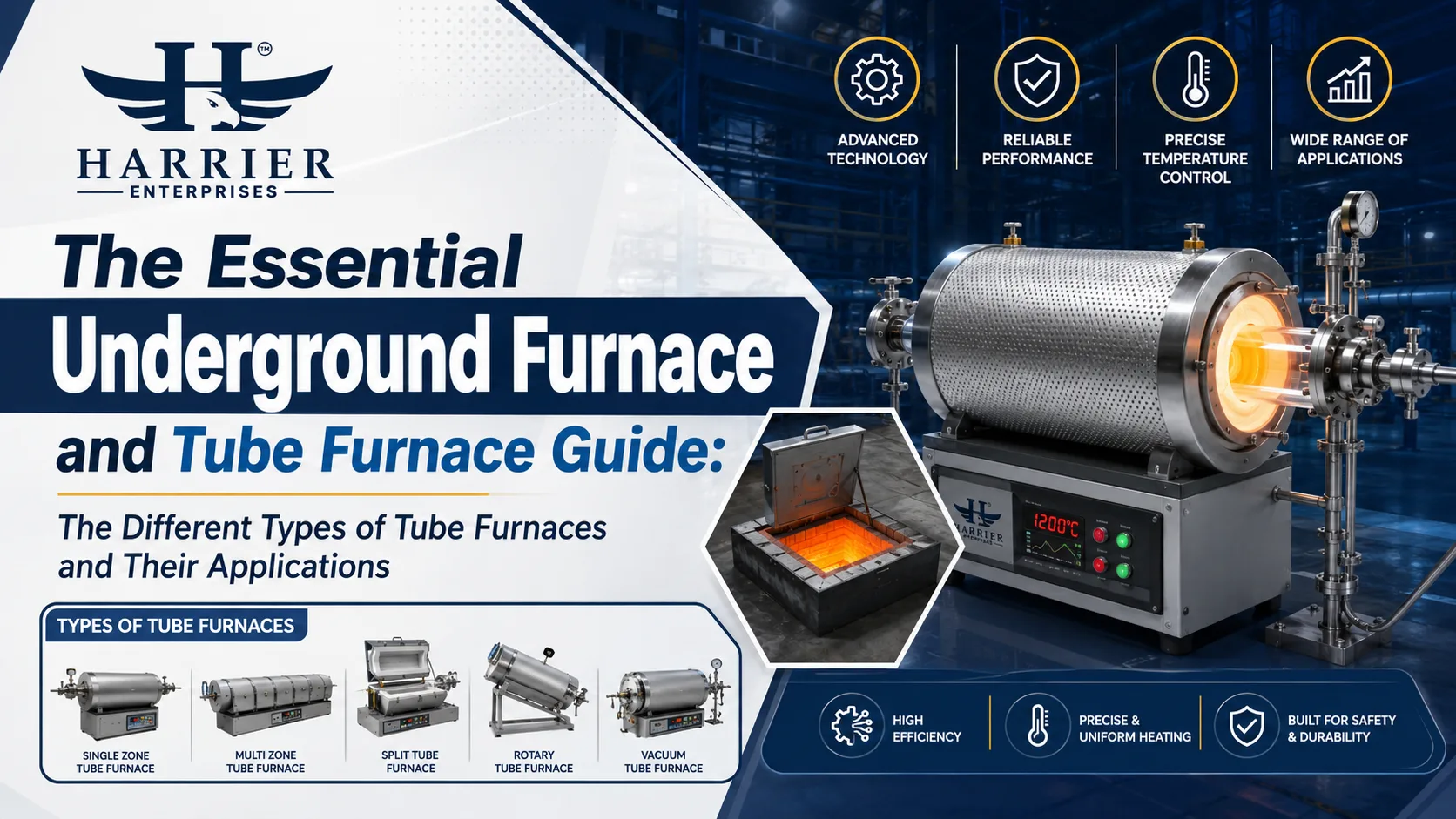
In present-day laboratories, research stations, universities, and industrial production plants, thermal processing equipment serves as an essential element in obtaining the required level of precision during heating and processing operations. The underground furnace and tube furnace represent one of the most popular high-temperature heating devices available on the market today. It finds a wide application in research, industrial manufacturing, and many other areas.
Muffle Furnace recognizes that the choice of the proper heating equipment is important. Whatever type of laboratory, heat treatment, sintering, annealing, or other operations you have to perform, it is important to use the right tube furnace for your needs.
This detailed overview describes various types of tube furnace equipment, explains its functioning principles, highlights key areas where such devices find application, enumerates advantages offered by each type of heating device, and compares tube furnaces with underground furnaces used in industrial applications.
What Is a Tube Furnace?
A tube furnace is an oven designed to provide high-temperature heating. It comprises a cylindrical heating unit having a tube within its center, where materials are placed to undergo heating at certain temperatures.
The main benefit of using a tube furnace is its capacity to allow uniform heating, along with controlling atmospheric conditions. Contemporary designs of tube furnaces have the capability to function in a vacuum, inert gas, hydrogen, nitrogen, argon, or even in air conditions.
A common tube furnace is extensively utilized by research laboratories, universities, metallurgical industries, ceramic factories, and other manufacturing industries.
Unlike the underground furnace, the tube furnace provides more temperature accuracy and control over the procedure.
How Does a Tube Furnace Work?
The working principle of a tube furnace is relatively straightforward. Electric heating elements surround a ceramic or quartz tube and generate controlled heat.
The process generally involves:
- Loading the sample into the tube.
- Setting the desired temperature profile.
- Introducing the required atmosphere.
- Heating the sample inside the tube furnace.
- Controlled cooling after processing.
The controlled environment inside a tube furnace makes it suitable for advanced thermal treatment applications. Unlike some traditional underground furnace systems, a tube furnace offers precise temperature programming and atmosphere control.
Types of Tube Furnace Systems
1. Horizontal Tube Furnace
The horizontal tube furnace is one of the most common configurations used in laboratories and industrial facilities.
Features include:
- Easy sample loading
- Uniform heating zones
- Excellent temperature control
- Suitable for research applications
Many research institutions prefer a horizontal tube furnace because it provides convenient access and consistent results.
2. Vertical Tube Furnace
A vertical tube furnace positions the heating chamber vertically.
Advantages include:
- Better sample suspension
- Gravity-assisted processing
- Reduced contamination risks
- Suitable for crystal growth studies
This type of tube furnace is often used in advanced material research where precise sample positioning is critical.
3. Split Tube Furnace
A split tube furnace features a hinged design that allows easy opening and closing of the heating chamber.
Benefits include:
- Easy maintenance
- Fast tube replacement
- Improved accessibility
- Flexible operation
The split tube furnace is commonly used in laboratories requiring frequent sample changes.
4. Vacuum Tube Furnace
A vacuum tube furnace operates under reduced pressure conditions.
Applications include:
- Metal heat treatment
- Semiconductor processing
- Nanomaterial research
- Advanced material synthesis
The vacuum tube furnace helps eliminate oxidation and contamination during high-temperature processes.
5. Multi-Zone Tube Furnace
A multi-zone tube furnace contains multiple independently controlled heating sections.
Advantages include:
- Precise temperature gradients
- Advanced thermal profiling
- Complex material processing
- Improved process consistency
Industries involved in advanced manufacturing often utilize a multi-zone tube furnace for highly specialized applications.
Understanding the Underground Furnace
While learning about the thermal processing apparatus, it becomes imperative to know the idea of an underground furnace.
Underground furnaces are generally placed either below the ground level or in pits that are especially constructed for certain industrial heating processes. There are some industries that use an underground furnace because large pieces of equipment need to be heated or there is a space problem.
As compared to a tube furnace, an underground furnace does not heat anything precisely but is intended for mass heating processes.
It all depends upon the nature of the process and the quantity of production.
Key Applications of Tube Furnace Systems
Material Science Research
The tube furnace is extensively used in material science laboratories for studying material behavior at elevated temperatures.
Researchers rely on the tube furnace for developing advanced ceramics, composites, and nanomaterials.
Heat Treatment Processes
Industrial heat treatment operations frequently use a tube furnace for annealing, tempering, and stress-relieving applications.
The precise control offered by a tube furnace ensures consistent material properties.
Semiconductor Manufacturing
The semiconductor industry utilizes a tube furnace for diffusion processes, oxidation, and wafer treatment.
A high-performance tube furnace helps achieve the strict quality standards required in semiconductor production.
Ceramic Processing
Ceramic manufacturers often depend on a tube furnace for sintering and firing applications.
The controlled atmosphere within a tube furnace enhances product quality and consistency.
Metallurgical Applications
Metallurgical laboratories use a tube furnace to study metal properties and conduct high-temperature experiments.
In comparison, an underground furnace may be used for larger industrial metal heating applications where bulk processing is required.
Advantages of Using a Tube Furnace
The popularity of the tube furnace is driven by numerous advantages:
Excellent Temperature Control
A modern tube furnace provides highly accurate temperature regulation.
Controlled Atmosphere
The ability to introduce gases into a tube furnace allows researchers to create specific processing environments.
Uniform Heating
The design of a tube furnace ensures consistent temperature distribution.
Versatile Applications
A single tube furnace can support multiple research and industrial applications.
Energy Efficiency
Many modern tube furnace systems are designed for efficient energy consumption.
These advantages make the tube furnace a preferred choice over many conventional heating systems, including certain underground furnace installations.
Tube Furnace vs Underground Furnace
| Feature | Tube Furnace | Underground Furnace |
|---|---|---|
| Temperature Precision | High | Moderate |
| Atmosphere Control | Excellent | Limited |
| Laboratory Use | Extensive | Rare |
| Industrial Bulk Processing | Moderate | High |
| Sample Handling | Easy | Complex |
| Research Applications | Ideal | Limited |
While the tube furnace is best suited for research and precision processing, an underground furnace is often preferred for large-scale industrial heating applications.
Selecting between a tube furnace and an underground furnace depends on the specific requirements of the operation.
Factors to Consider When Choosing a Tube Furnace
Before purchasing a tube furnace, consider the following:
Maximum Temperature
Different tube furnace models support varying temperature ranges.
Tube Material
Quartz, alumina, and ceramic tubes are commonly used in a tube furnace.
Heating Zone Length
The heating zone determines the effective processing area inside the tube furnace.
Atmosphere Requirements
Choose a tube furnace capable of supporting your required gas environment.
Control System
Modern tube furnace systems feature programmable digital controllers for improved process accuracy.
Future Trends in Tube Furnace Technology
The future of the tube furnace industry includes:
- Smart temperature monitoring
- Automated process control
- Energy-efficient heating systems
- IoT integration
- Advanced vacuum technology
These innovations are helping the tube furnace remain one of the most important thermal processing tools in research and industrial applications.
Even industries using an underground furnace are adopting advanced automation technologies to improve efficiency and process control.
Conclusion
The underground furnace and tube furnace can be considered one of the most flexible and durable thermal devices used in laboratory experiments, materials science, heat treatment, and industrial production processes. The accuracy of temperature regulation, the ability to create any atmosphere, and diverse designs provide the opportunity to use a tube furnace in many different fields.
Understanding the need for choosing appropriate thermal devices at Muffle Furnace, we know that you may require either a laboratory tube furnace for more sophisticated experiments or the comparison of your solution with the underground furnace in terms of its benefits for industrial purposes.
Despite the development of modern technologies, the tube furnace will continue to play an important role.