

In more sophisticated fields such as advanced material science, semiconductor fabrication processes, nanotechnology, and laboratory testing, a uniformly coated thin film is crucial in determining the reliability and accuracy of the products. One of the widely employed procedures to coat high-quality thin films is the Programmable Spin Coating technique, which is known for its ability to yield high precision, consistent, and uniform coating on flat surfaces.
The increasing need for coating equipment in the world today is recognized by Muffle Furnace. A Programmable Spin Coating Unit is an elaborate machine that aims to automate the spin coating process for greater precision. With a wide array of applications ranging from polymeric solutions, nanoparticle solutions, photo-resists, and other electronic materials, knowing about what is spin coating procedures could increase coating efficiency and effectiveness.
This informative article will take a look at the definition of what is spin coating, how a programmable spincoating unit works, the benefits of spin coating, its uses in industry, and why it is imperative to employ the use of a programmable spin coating unit.
What is Spin Coating?
The question what is spin coating is one of the commonly asked queries in the laboratories of material processing.
The spin coating process is a method where a thin and uniform film of liquid is applied on a planar surface using the fast rotation of a substrate. During this procedure, liquid material is distributed homogeneously along the surface due to centrifugal forces, thus forming an ultra-thin film of equal thickness.
In order to clarify what is spin coating, you have to visualize a process where several drops of coating material are placed in the middle of a substrate that rotates fast making the liquid form thin films.
Spincoating gains its popularity for numerous reasons, among which are high precision and repeatability. The knowledge of what is spin coating is necessary for industries like electronics, optics, solar cells, biomedical devices, and the semiconductor industry.
What is a Programmable Spin Coating Unit?
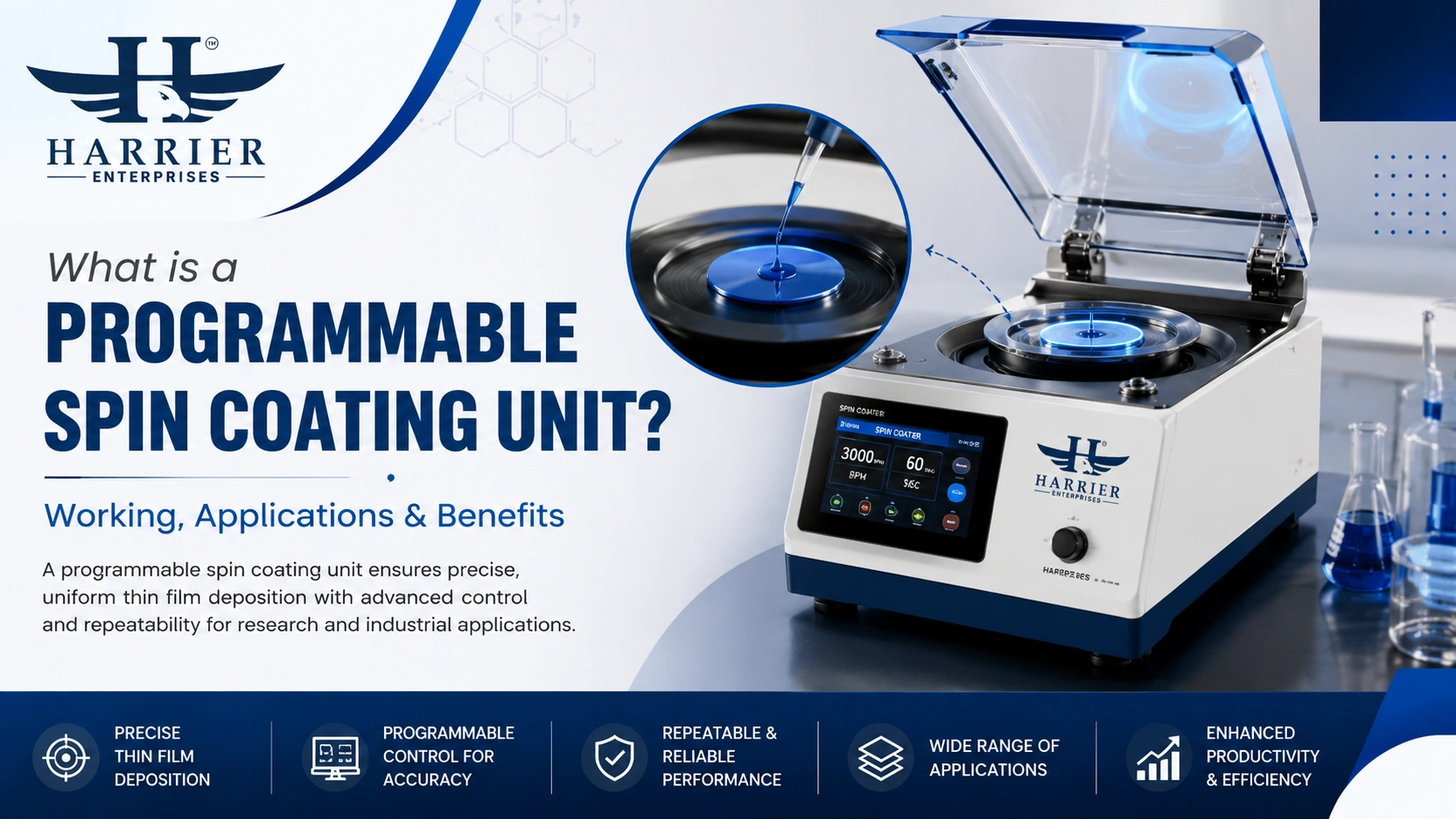
A Programmable Spin Coating Unit is an advanced machine specifically designed to automate the spin coating process.
Unlike conventional systems, a programmable unit allows users to set and control various parameters, such as:
- Rotation speed
- Acceleration rate
- Deceleration rate
- Coating duration
- Multiple coating cycles
- Process recipes
A programmable spin coating apparatus guarantees that all spin coating operations are carried out under the same conditions, leading to consistent film quality.
The main function of a programmable device is to avoid any errors and increase the effectiveness of the spincoating process. The contemporary laboratory favors programmable devices because they reduce the complexity of a process while retaining accuracy.
Working Principle of a Programmable Spin Coating Unit
Understanding the spin coating process helps users maximize the performance of the equipment.
Step 1: Substrate Placement
The substrate is securely positioned on the vacuum chuck of the machine.
Step 2: Dispensing the Solution
A measured quantity of coating solution is deposited at the center of the substrate.
Step 3: Initial Spread Cycle
The machine begins rotating at a lower speed, allowing the liquid to spread evenly.
Step 4: High-Speed Spin Coat Stage
The unit accelerates to a predefined speed. During this spin coat phase, excess material is removed, leaving behind a uniform thin film.
Step 5: Drying and Stabilization
As the spin coating process continues, solvent evaporation occurs, resulting in the desired film thickness.
Step 6: Completion
The substrate is removed and prepared for further processing.
The programmable control system ensures that every spin coat cycle follows the same parameters, producing highly repeatable results.
Major Components of a Programmable Spin Coating Unit
A modern spin coating system consists of several important components.
Vacuum Chuck
The vacuum chuck securely holds the substrate during the spincoating operation.
Motor Assembly
A high-speed motor drives the substrate rotation required for the spin coating process.
Programmable Controller
The controller manages speed profiles, timing sequences, and coating recipes.
Solution Dispensing Area
This area allows precise application of the coating material before the spin coat cycle begins.
Safety Enclosure
The enclosure protects users from splashes and ensures safe spincoating operation.
Digital Display
The display enables operators to monitor and adjust the spin coating parameters accurately.
Advantages of Spin Coating Technology
The widespread adoption of spin coating is due to its numerous benefits.
Excellent Film Uniformity
The spin coating process produces highly uniform films across the entire substrate surface.
Precise Thickness Control
Users can control film thickness by adjusting speed and time during the spin coat cycle.
High Repeatability
Programmable spincoating systems deliver consistent results in every operation.
Fast Processing
The spin coating technique requires only a few seconds to create thin films.
Cost-Effective Operation
Compared to many deposition methods, spincoating requires relatively simple equipment and lower operating costs.
Easy Automation
A programmable spin coating unit can store multiple recipes for repeated production tasks.
Applications of Spin Coating
The versatility of spin coating makes it suitable for numerous industries.
Semiconductor Industry
The spin coating process is extensively used for photoresist application during semiconductor manufacturing.
Nanotechnology Research
Researchers use spincoating to prepare thin films and nanomaterial coatings.
Solar Cell Manufacturing
The spin coat technique helps create uniform active layers in photovoltaic devices.
Optical Coatings
High-quality optical films are often produced using spin coating systems.
Biomedical Devices
The spin coating process is used for coating medical sensors and diagnostic components.
MEMS Manufacturing
Microelectromechanical systems frequently depend on spincoating for thin-film deposition.
Academic Research
Universities and research institutions use spin coating equipment for experimental studies and material development.
Factors Affecting Spin Coating Results
Several factors influence the effectiveness of the spin coating process.
Spin Speed
Higher speeds generally produce thinner films during the spin coat operation.
Solution Viscosity
The viscosity of the material significantly impacts spin coating performance.
Spin Time
Longer processing times can alter film thickness and uniformity.
Solvent Evaporation Rate
Solvent behavior affects the outcome of the spincoating process.
Substrate Surface Quality
A clean substrate improves the quality of the spin coating layer.
Environmental Conditions
Temperature and humidity can influence the spin coating process results.
Why Choose a Programmable Spin Coating Unit?
A programmable spin coating unit offers substantial advantages over manual systems.
Greater Precision
Automated controls improve spin coating consistency.
Recipe Storage
Users can save multiple spincoating programs for different applications.
Reduced Human Error
Programmable settings ensure every spin coat cycle follows the same process.
Improved Productivity
Automation reduces setup time and increases throughput.
Better Research Outcomes
Accurate process control improves experimental reliability in programmable spin coating applications.
Maintenance Tips for Spin Coating Units
Proper maintenance extends the life of your spin coating equipment.
- Clean the vacuum chuck regularly.
- Remove residual coating materials after each spin coat cycle.
- Inspect motor performance periodically.
- Verify vacuum system functionality.
- Calibrate the controller when required.
- Maintain a dust-free operating environment.
Routine servicing ensures optimal spincoating performance and long-term reliability.
Conclusion
What is spin coating is an important consideration for any scientist or manufacturing expert working on thin film applications. Spin coating technology provides a dependable and economical means of creating thin films that require extremely high levels of accuracy. A programmable spin coater allows for greater effectiveness in the process by making it automated, repeatable, and consistent.
Muffle Furnace is a leading supplier of lab equipment for current research and manufacturing purposes. If you are considering “what is spin coating” or looking for a programmable spin coating unit, we offer a solution that may meet your requirements.