

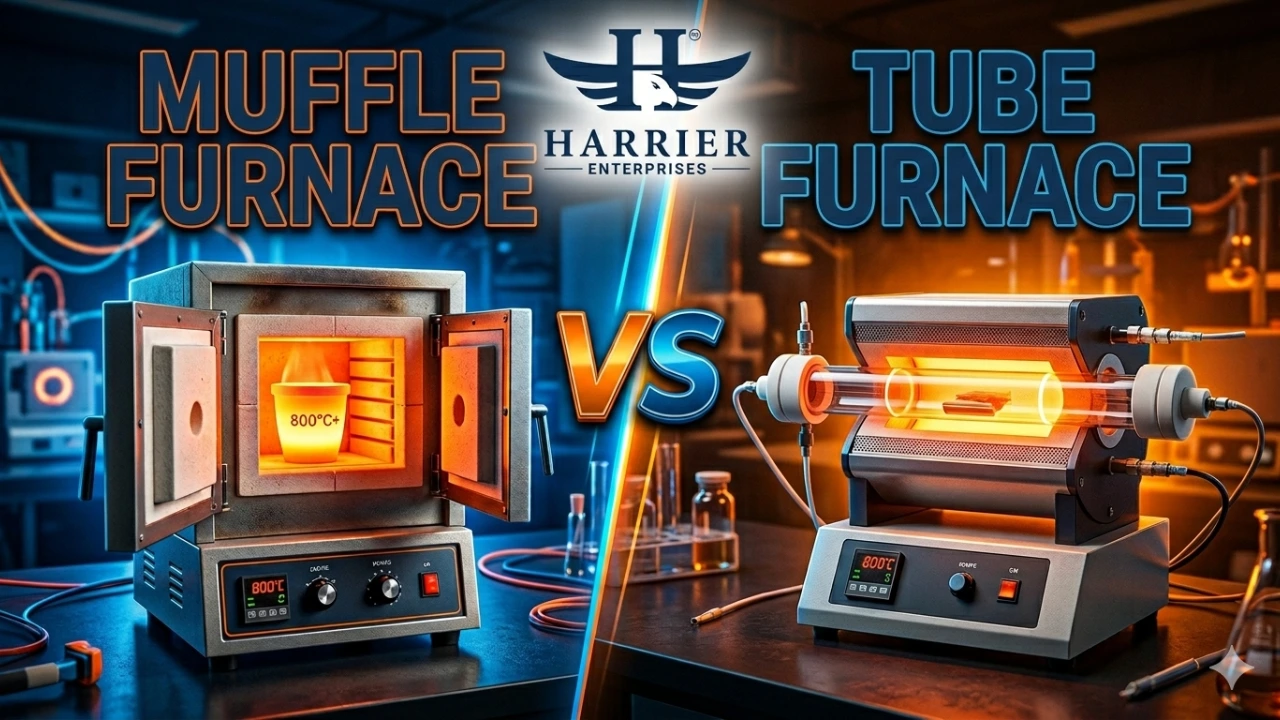
The Muffle Furnace and TubeFurnace serve as two reliable heating systems that researchers, industrial manufacturers, and materials testers can choose for their laboratory, industrial, and material testing needs. Both furnaces provide high-temperature heating capabilities, yet their applications differ based on the specific requirements of the process and sample, and temperature needs. Understanding the Difference between a tube furnace and a muffle-furnace can help buyers make the right investment for long-term performance and efficiency.
Muffle Furnace offers advanced heating equipment that functions with high precision and durability to deliver reliable performance throughout various industrial applications.
What is a Muffle Furnace?
A Muffle-Furnace functions as a box-shaped heating chamber that holds materials in its insulated interior space. The heating elements create a barrier between them and the sample material, which guarantees clean, contamination-free heating. This furnace is commonly used in laboratories, ceramics, metallurgy, pharmaceuticals, and quality testing.
The Muffle Furnace Temperature control system allows the temperature to reach both moderate and extremely high temperatures according to the specific furnace model, which makes it suitable for conducting ash tests, heat treatments, drying processes, and sample preparation work.
Common Muffle Furnace Use
- Ash determination %Heat treatment of metal
- Ceramic firing
- Ceramic firing
- Glass testing
- Material research
- Chemical analysis
- Drying and preheating of samples
With an enclosed chamber, the Muffle-Furnace is widely used in applications necessitating uniform heating in a clean environment.
What is a Tube Furnace?
A Tube Furnace uses a cylindrical tube, which engineers install inside a temperature-controlled chamber. The tube serves as a processing area, which operators use to introduce samples that undergo treatment in various atmospheric conditions, including vacuum, inert gas, and hydrogen and nitrogen. This design enables advanced research applications in material science research experiments.
The Tube Furnace operates widely across multiple fields, including laboratory research, semiconductor production, nanotechnology, catalyst testing, and thermal decomposition research.
Common Tube Furnace Use
- Annealing Materials:
- Sintering of Powders
- Chemical Vapor Deposition
- Calcination under gas flow
- Carbonization processes
- Thermal decomposition studies
- Research under an inert atmosphere.
A Tube Furnace becomes extremely useful when you need to have proper atmosphere control and precise heating zones.
Difference between Tube Furnace and Muffle Furnace
| Usually operates in a normal air atmosphere | Tube Furnace | Muffle-Furnace |
|---|---|---|
| Design Structure | Cylindrical tube placed inside a heating chamber | Box-shaped insulated chamber |
| Heating Method | Heats samples inside a ceramic or quartz tube | Heats samples inside an enclosed chamber |
| Atmosphere Control | Supports vacuum, inert gas, hydrogen, nitrogen | Usually operates in normal air atmosphere |
| Best For | Research, material processing, gas-controlled experiments | Ashing, heat treatment, drying, testing |
| Sample Type | Rods, wafers, powders, small samples | Bulk samples, crucibles, trays |
| Temperature Zones | Single zone or multi-zone heating available | Uniform chamber heating |
| Loading Process | Samples inserted through tube ends | Front-loading chamber door |
| Precision Level | High precision for thermal processes | Excellent for general laboratory heating |
| Common Industries | Semiconductor, nanotechnology, R&D labs | Laboratories, ceramics, metallurgy |
| Maintenance | Tube replacement may be required over time | Easier chamber cleaning and maintenance |
| Cost Range | Generally higher due to advanced features | More cost-effective for standard use |
| Ideal Choice | Controlled atmosphere applications | A cylindrical tube placed inside a heating chamber |
Which Furnace Is Best for Your Needs?
Your answer will depend on the specific work methods that you will use.
Choose a Muffle Furnace If You Need:
- General laboratory heating
- Ashing and combustion testing
- Heat treatment applications
- Easy loading and unloading
- Uniform chamber heating
- Cost-effective routine furnace operation
Choose a Tube Furnace If You Need:
- Controlled gas atmosphere processing
- Material research and development
- Continuous tube heating
- Multi-zone temperature profiles
- Semiconductor or catalyst studies
- Precision thermal experiments
Why Muffle Furnace Temperature Matters
The selection process requires Muffle-Furnace Temperature because it is an essential factor that needs to be determined. Different materials require different heat ranges. The process requires specific temperatures because low temperatures fail to complete it, while excessive heat results in sample destruction.
Typical temperature ranges include:
- 900°C for drying and basic heating
- 1200°C for ash testing and ceramics
- 1400°C to 1700°C for advanced material treatment
Muffle-Furnace provides dependable systems that meet different temperature requirements.
Benefits of Buying from Muffle Furnace
Muffle-Furnace provides you with reliable heating systems that meet the requirements of contemporary industrial applications.
- Our Advantages:
- Precision temperature controllers
- Durable insulation systems
- Energy-efficient designs
- Laboratory and industrial models
- High safety standards
- Custom furnace options
- Excellent after-sales support
The Muffle-Furnace and Tube Furnace both provide you with durable construction, which guarantees extended operational life and steady performance.
Conclusion
The two systems operate at high efficiency, yet the correct system for you will depend on your specific usage needs. The Muffle Furnace provides an ideal solution when you require basic chamber heating for your standard testing procedures. The Tube Furnace serves as the superior equipment when your process demands both atmospheric regulation and precise thermal control capabilities.
The Difference between a tube furnace and a muffle-furnace enables industries, laboratories, and researchers to choose equipment that enhances their operational efficiency and accuracy of their processes.