

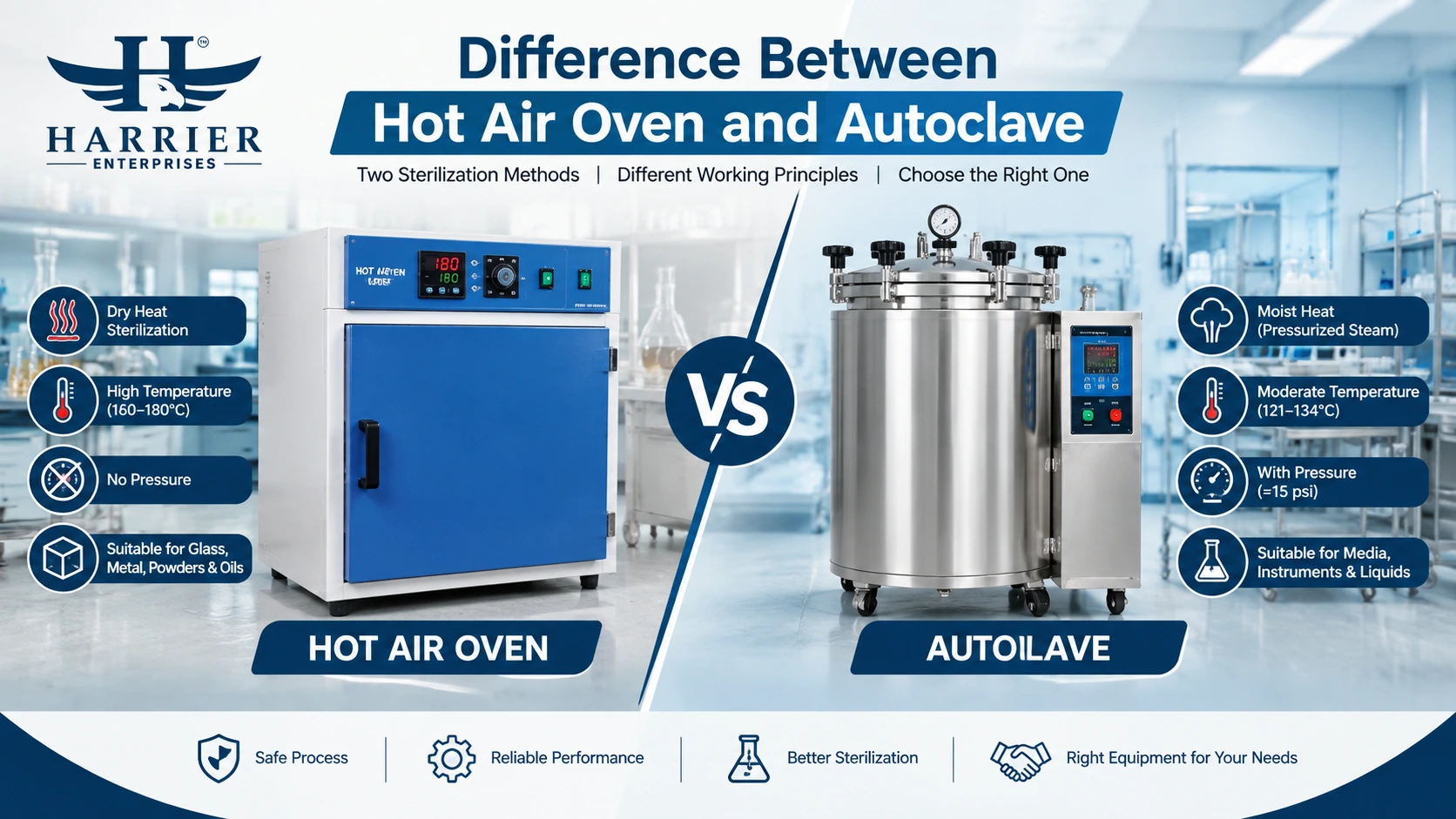
Choosing the right sterilization equipment is important for laboratories, hospitals, pharmaceutical units, research facilities, and industrial applications. Two commonly used systems are the hot air oven and autoclave, but they do not sterilize materials in the same way. One uses dry heat, while the other uses pressurized steam. This basic difference affects temperature, sterilization time, material compatibility, operating conditions, and applications.
Understanding the difference between hot air oven and autoclave helps users select the correct equipment for a particular material and sterilization requirement. While a hot air oven is generally suitable for dry, heat-resistant materials such as glassware, metal instruments, powders, and oils, an autoclave is widely used for culture media, surgical instruments, laboratory waste, and other moisture-compatible materials.
In this guide, we explain hot air oven and autoclave, their working principles, temperature and pressure conditions, applications, advantages, limitations, maintenance requirements, and the important factors to consider before selecting either system.
What Is a Hot Air Oven?
A hot air oven is a laboratory sterilization and heating chamber that uses dry, heated air to destroy microorganisms. Heat is circulated inside an insulated chamber, allowing the required temperature to be maintained for a specified period.
The hot air oven and autoclave are often compared because both can be used for sterilization, but their operating principles are different. A hot air oven does not use steam or pressure. Instead, sterilization takes place through dry heat and oxidation of microbial cell components.
Typical laboratory hot air ovens may operate at approximately 50°C to 250°C or higher, depending on the model and application. Common sterilization cycles can include conditions such as 160°C for around 120 minutes, 170°C for around 60 minutes, or 180°C for around 30 minutes after the required operating temperature has been reached. Actual cycle requirements depend on the equipment, load, validation method, and applicable standard.
How Does a Hot Air Oven Work?
The working process of a hot air oven generally involves the following steps:
- The material is placed inside the sterilization chamber.
- The chamber door is closed properly.
- Heating elements raise the chamber temperature.
- A natural or forced-air circulation system distributes heat.
- The selected temperature is maintained for the required holding time.
- Dry heat penetrates the exposed surfaces of the load.
- Microorganisms are destroyed through thermal damage and oxidation.
- After the cycle, the chamber is allowed to cool before unloading.
The effectiveness of dry-heat sterilization depends on temperature, exposure time, load arrangement, airflow, and heat penetration.
What Is an Autoclave?
An autoclave is a sterilization system that uses saturated steam under pressure to destroy microorganisms. Pressure itself is not the primary sterilizing agent; it allows steam to reach temperatures above the normal boiling point of water.
Common laboratory autoclave cycles operate around 121°C at approximately 15 psi gauge pressure for about 15–30 minutes, although longer cycles may be required depending on load type, volume, packaging, and validation requirements. Some applications use approximately 132–134°C for shorter exposure periods.
Unlike dry-heat sterilization, steam transfers heat efficiently when it contacts the load and condenses on cooler surfaces.
How Does an Autoclave Work?
A typical autoclave cycle includes:
- Loading the chamber with steam-compatible material.
- Removing or displacing air from the chamber.
- Introducing steam.
- Increasing chamber temperature and pressure.
- Maintaining the selected sterilization temperature for the required holding time.
- Exhausting steam according to the selected cycle.
- Drying the load when the equipment provides a drying phase.
- Allowing safe pressure equalization before opening the door.
The difference between autoclave and hot air oven becomes particularly clear here: the hot air oven relies on dry heat, while the autoclave relies on saturated steam under controlled pressure.
Hot Air Oven vs Autoclave: What Is the Main Difference?
The most important hot air oven vs autoclave difference is the sterilization medium.
A hot air oven uses dry heat, whereas an autoclave uses moist heat in the form of pressurized saturated steam. Because steam transfers heat more efficiently than dry air, autoclaves can generally achieve sterilization at lower temperatures and shorter exposure times for appropriate loads.
The hot air oven and autoclave difference also affects which materials can safely be processed.
Glassware, metal instruments, powders, and certain oils may be appropriate for dry heat, while culture media, many reusable surgical instruments, laboratory waste, and aqueous solutions are generally better suited to steam sterilization when compatible with the process.
Hot Air Oven and Autoclave Comparison Table
| Parameter | Hot Air Oven | Autoclave |
|---|---|---|
| Sterilization method | Dry heat | Moist heat/steam |
| Main medium | Heated air | Saturated steam |
| Typical temperature | Around 160–180°C for common dry-heat cycles | Commonly 121–134°C |
| Pressure | Atmospheric pressure | Elevated chamber pressure |
| Example operating condition | 160°C for ~120 min | 121°C at ~15 psi for ~15–30 min |
| Moisture | No steam required | Steam required |
| Heat transfer | Relatively slower | Highly efficient through steam condensation |
| Suitable materials | Glass, metal, powders, selected oils | Culture media, compatible instruments, liquids, many laboratory materials |
| Plastic compatibility | Depends on material temperature resistance | Depends on steam and temperature resistance |
| Paper/cardboard | Limited and application-dependent | Only when specifically designed for steam sterilization |
| Oils | Suitable for certain dry-heat applications | Generally unsuitable for routine steam sterilization |
| Powders | Can be suitable | Usually not preferred |
| Liquid sterilization | Generally unsuitable for many liquid applications | Common application when container and cycle are suitable |
| Sterilization time | Generally longer | Generally shorter |
| Corrosion risk | Lower moisture-related corrosion | Moisture can increase corrosion risk for some metals |
| Drying | Naturally dry process | Drying phase may be required |
| Pressure vessel | Not normally required | Required |
| Maintenance | Heating, airflow and temperature controls | Steam generation, chamber, gasket, valves and safety system |
| Typical applications | Glassware, metal, powders, oils | Media, instruments, waste and steam-compatible materials |
The exact operating parameters should always be established and validated according to the equipment manufacturer’s instructions and the intended application.
Difference Between Hot Air Oven and Autoclave Based on Temperature
Temperature is one of the most searched aspects of the difference between hot air oven and autoclave.
A hot air oven generally requires a higher temperature because dry air transfers heat less efficiently than saturated steam. Common dry-heat sterilization conditions may use approximately 160°C, 170°C, or 180°C for defined exposure periods.
An autoclave commonly operates at approximately 121°C or 132–134°C, depending on the cycle. For example, a widely used steam cycle is around 121°C at approximately 15 psi gauge pressure.
However, temperature alone does not determine sterilization effectiveness. Exposure time, heat penetration, steam quality, load configuration, air removal, and cycle validation are also important.
Difference Between Hot Air Oven and Autoclave Based on Pressure
Pressure is another major hot air oven and autoclave difference.
A hot air oven normally operates without the elevated pressure used by an autoclave. Its sterilization process depends mainly on maintaining the required dry-heat temperature for sufficient time.
An autoclave operates as a pressure vessel. Increasing pressure allows saturated steam to reach temperatures above 100°C. For example, approximately 15 psi gauge pressure corresponds to a saturated steam temperature of about 121°C under standard reference conditions.
Therefore, users should never treat pressure and temperature as interchangeable parameters. An autoclave cycle must be controlled using the validated temperature-pressure relationship and cycle requirements.
Difference Between Hot Air Oven and Autoclave Based on Sterilization Time
The hot air oven vs autoclave comparison also differs significantly in cycle duration.
Dry heat generally requires longer exposure because heat penetration and microbial destruction are slower. A cycle may involve 160°C for approximately two hours, depending on the application.
Steam sterilization can be considerably faster because condensation of steam transfers a large amount of heat to the load. A common example is approximately 121°C for 15–30 minutes, although the complete cycle can take longer because of air removal, heating, cooling, exhaust, and drying.
The correct cycle should be determined by the load and validated process rather than simply selecting the shortest available time.
Which Materials Are Suitable for a Hot Air Oven?
A hot air oven is commonly considered for:
- Glass Petri dishes
- Glass bottles and test tubes
- Metal instruments
- Stainless-steel components
- Certain powders
- Certain oils and non-aqueous materials
- Heat-resistant laboratory accessories
Materials must be able to withstand the selected temperature without melting, degrading, burning, deforming, or otherwise changing their required properties.
Which Materials Are Suitable for an Autoclave?
Autoclaves are commonly used for:
- Microbiological culture media
- Steam-compatible laboratory glassware
- Reusable surgical instruments
- Laboratory waste
- Certain heat-resistant plastics
- Aqueous solutions
- Compatible gowns, dressings, and other materials
The material must be compatible with heat, moisture, pressure, and the selected cycle.
Sealed containers should not be placed into an autoclave unless they are specifically designed and prepared for the process, because pressure differences can create serious hazards.
Hot Air Oven vs Autoclave for Glassware
Both systems can be used for suitable glassware, but the choice depends on the application.
Dry glassware is often well suited to a hot air oven because the process does not introduce moisture. This can be useful where completely dry equipment is required immediately after sterilization.
Autoclaves can also process compatible glassware, particularly when rapid steam sterilization is desired. However, appropriate loading, temperature resistance, pressure compatibility, and cooling procedures are essential.
Therefore, the difference between hot air oven and autoclave for glassware is not simply that one works and the other does not; the better choice depends on the glassware design and process requirement.
Hot Air Oven vs Autoclave for Liquids
For aqueous laboratory media and other compatible liquids, an autoclave is generally the more appropriate sterilization technology because steam can efficiently transfer heat to the liquid.
A hot air oven is generally not the first choice for aqueous liquids because dry heat does not provide the same efficient heat-transfer mechanism.
For liquid autoclave cycles, container size, fill volume, venting, temperature profile, cooling time, and container compatibility must be considered.
Hot Air Oven vs Autoclave for Powders and Oils
Certain powders and oils can be suitable for dry-heat sterilization because steam may not penetrate or interact with them in the desired way.
This is one of the areas where the hot air oven and autoclave have distinctly different application profiles.
However, not every powder or oil can simply be placed into a hot air oven. The required temperature, exposure time, thermal stability, container design, and validated sterilization method must be evaluated before processing.
Advantages of a Hot Air Oven
Key advantages include:
- Dry sterilization process
- Suitable for many glass and metal items
- No steam generation required
- Useful for selected powders and oils
- No moisture left on the load
- Relatively straightforward operation
- Suitable for high-temperature applications
Limitations of a Hot Air Oven
Some limitations include:
- Higher operating temperatures
- Longer exposure times
- Slower heat penetration
- Not suitable for many heat-sensitive materials
- Not suitable for many aqueous liquids
- Improper loading can create temperature differences
- Excessive temperature can damage materials
Advantages of an Autoclave
Major advantages include:
- Efficient steam-based heat transfer
- Lower sterilization temperature than many dry-heat cycles
- Shorter exposure time for suitable loads
- Suitable for many aqueous laboratory materials
- Effective for compatible instruments and laboratory waste
- Automated cycles are available on many modern systems
- Temperature, pressure and time can be monitored
Limitations of an Autoclave
Potential limitations include:
- Requires steam
- Requires pressure-vessel safety systems
- Not suitable for all materials
- Moisture can affect some materials
- Some metals may experience corrosion
- Sealed containers can be hazardous
- Proper loading and air removal are critical
- Regular maintenance is required
Common Mistakes When Using a Hot Air Oven
Several operating mistakes can reduce process reliability:
Overloading the Chamber
Overloading can restrict airflow and create temperature differences. Leave sufficient space around materials for proper circulation.
Using the Wrong Temperature
Higher temperature does not automatically mean better sterilization. Excessive temperature can damage materials.
Starting the Timer Too Early
For validated processes, exposure time should correspond to the required temperature conditions. Starting the holding timer before the load reaches the required condition can produce an inadequate cycle.
Opening the Door Too Early
Opening the door can disturb the temperature profile and expose users to hot surfaces and air.
Common Mistakes When Using an Autoclave
Overpacking
Overpacked chambers can restrict steam penetration and air removal.
Sealing Containers Completely
Sealed containers can create dangerous pressure differences during heating and cooling.
Mixing Incompatible Loads
Different materials may require different cycle conditions. Combining unsuitable loads can compromise processing.
Ignoring the Cooling Stage
Pressure must return to a safe level before opening the chamber. Hot liquids can also boil suddenly if pressure is released improperly.
Maintenance Requirements for Hot Air Ovens
Routine maintenance should include:
- Checking temperature accuracy
- Inspecting heating elements
- Checking airflow and circulation
- Cleaning the chamber
- Inspecting door seals
- Verifying controller operation
- Checking temperature uniformity periodically
- Calibrating sensors where required
- Recording maintenance and validation activities
Regular calibration and temperature mapping can be important for applications requiring documented process control.
Maintenance Requirements for Autoclaves
Important maintenance activities may include:
- Checking chamber condition
- Inspecting door gasket
- Checking pressure and temperature sensors
- Inspecting safety valves
- Checking steam generation system
- Cleaning the chamber and drain
- Checking water quality where applicable
- Verifying alarms and interlocks
- Performing calibration and validation
- Maintaining service records
Because an autoclave is a pressure vessel, safety inspections and servicing should follow the manufacturer’s instructions and applicable local requirements.
Safety Tips for Hot Air Ovens
- Use heat-resistant gloves when unloading.
- Do not touch hot internal surfaces.
- Avoid combustible materials unless specifically approved.
- Do not exceed the equipment’s rated temperature.
- Keep ventilation requirements in mind.
- Avoid blocking airflow.
- Allow the load to cool before handling.
- Follow the manufacturer’s operating instructions.
Safety Tips for Autoclaves
- Never open the door while the chamber is under unsafe pressure.
- Use appropriate PPE.
- Check the gasket and door-locking mechanism.
- Do not process incompatible materials.
- Avoid sealed containers.
- Use suitable trays and secondary containment where required.
- Allow adequate cooling before handling.
- Follow validated loading and cycle procedures.
- Maintain pressure-vessel safety systems according to applicable requirements.
How to Choose Between a Hot Air Oven and Autoclave?
The right selection depends on the material and sterilization requirement rather than simply choosing the machine with the higher temperature.
Choose a hot air oven when the application requires dry heat and the material can tolerate high temperatures. It is commonly considered for glassware, metal equipment, powders, and selected oils.
Choose an autoclave when the material is compatible with steam and the process benefits from efficient moist-heat sterilization. It is commonly used for culture media, aqueous materials, compatible instruments, and laboratory waste.
Before purchasing equipment, consider:
- Required sterilization method
- Material compatibility
- Operating temperature
- Required exposure time
- Chamber capacity
- Load dimensions
- Temperature uniformity
- Pressure requirements
- Steam quality
- Controller accuracy
- Safety interlocks
- Calibration requirements
- Energy consumption
- Maintenance requirements
- Validation requirements
- Available laboratory space
- Service and spare-parts support
Capacity and Chamber Size Considerations
Equipment capacity should be selected according to the actual load rather than maximum advertised volume.
For hot air ovens, consider the number and dimensions of trays, glassware arrangement, airflow around the load, and required temperature uniformity.
For autoclaves, consider chamber volume, vessel dimensions, load type, liquid volume, steam penetration, and cycle duration.
A larger chamber can increase productivity, but it may also require greater energy and longer heating or cooling periods. Therefore, capacity should be matched to daily workload.
Energy Requirement: Hot Air Oven vs Autoclave
Energy consumption varies substantially between models and operating conditions.
A hot air oven primarily consumes electrical energy for heating and, where provided, air circulation.
An autoclave may consume energy for electrical heating, steam generation, pumps, vacuum systems, drying, and other supporting functions depending on its design.
Actual energy consumption should therefore be evaluated using the manufacturer’s rated power, cycle duration, load size, and number of cycles per day.
Hot Air Oven and Autoclave: Which One Should You Buy?
There is no single machine that is suitable for every sterilization application.
If your primary requirement is dry-heat sterilization, especially for heat-resistant glass, metal, selected powders, or oils, a hot air oven may be appropriate.
If your requirement involves steam sterilization of compatible liquids, culture media, instruments, or laboratory waste, an autoclave may be more suitable.
When evaluating a hot air oven, look at temperature range, chamber construction, insulation, airflow system, controller accuracy, safety features, tray capacity, and temperature uniformity.
When evaluating an autoclave, check chamber capacity, operating temperature and pressure, steam generation, air removal method, safety interlocks, drying system, controller, validation features, and service support.
Why Choose Muffle Furnaces for Laboratory Heating Equipment?
Muffle Furnaces focuses on laboratory and industrial heating equipment where controlled temperature, dependable construction, and application-specific performance are important.
When selecting equipment, users should consider more than only the machine’s maximum temperature. Chamber size, temperature control, insulation, heating uniformity, operating cycle, safety features, material compatibility, and after-sales support can significantly affect long-term performance.
For applications requiring controlled high-temperature heating or laboratory thermal processing, discussing the required operating conditions with an equipment specialist can help identify a suitable configuration.
Suggested Internal Linking Opportunities
For a website covering laboratory and heating equipment, relevant internal links can be placed naturally around:
- Hot Air Oven
- Laboratory Oven
- Industrial Oven
- Muffle Furnace
- Laboratory Heating Equipment
- High Temperature Furnace
- Laboratory Equipment
- Temperature-Controlled Ovens
Use descriptive anchor text rather than repeatedly using exact-match keywords.
Technical Standards and Trust Signals
For professional or regulated applications, equipment selection and sterilization processes should be evaluated against the relevant standards and institutional procedures. Depending on the application, users may need to consider standards and guidance related to steam sterilization, dry-heat sterilization, biological indicators, temperature calibration, pressure-vessel safety, and validation.
Manufacturers should provide technical documentation such as operating manuals, specifications, calibration information, safety features, and applicable test or validation documentation where relevant.
Frequently Asked Questions
1. What is the difference between hot air oven and autoclave?
The main difference between hot air oven and autoclave is the sterilization method. A hot air oven uses dry heat, while an autoclave uses saturated steam under pressure.
2. What is the difference between autoclave and hot air oven in temperature?
A hot air oven commonly uses higher temperatures such as 160–180°C for validated dry-heat cycles, while an autoclave commonly uses around 121°C or 132–134°C depending on the cycle.
3. Which is better, hot air oven or autoclave?
Neither is universally better. A hot air oven is suitable for appropriate dry-heat applications, while an autoclave is generally preferred for compatible steam-sterilizable materials.
4. What is the working principle of a hot air oven?
A hot air oven uses controlled dry heat. Heated air circulates around the load and maintains the required temperature for a specified exposure period.
5. How does an autoclave sterilize materials?
An autoclave uses saturated steam under pressure. Steam transfers heat efficiently to compatible materials, and the validated combination of temperature and exposure time destroys microorganisms.
6. What temperature is commonly used in an autoclave?
A common steam sterilization condition is approximately 121°C at around 15 psi gauge pressure, although other cycles such as 132–134°C may also be used.
7. What temperature is commonly used in a hot air oven?
Common dry-heat sterilization cycles may use approximately 160°C, 170°C, or 180°C with defined exposure times. The correct condition depends on the load and validated process.
8. Can glassware be sterilized in both a hot air oven and an autoclave?
Yes, suitable glassware can often be processed by either method. The choice depends on the glassware design, required process, moisture tolerance, cycle conditions, and application.
9. Can liquids be sterilized in a hot air oven?
A hot air oven is generally not preferred for aqueous liquids. An autoclave is commonly used for compatible aqueous materials because steam provides efficient heat transfer.
10. Why does an autoclave use pressure?
Pressure allows saturated steam to reach temperatures above the normal boiling point of water. The pressure itself is not the primary sterilizing mechanism; the heat delivered by saturated steam is critical.
Final Conclusion
The difference between hot air oven and autoclave is mainly based on their sterilization method, operating temperature, pressure, exposure time, and material compatibility. A hot air oven uses dry heat and is commonly suitable for heat-resistant glass, metal, powders, and selected oils. An autoclave uses pressurized saturated steam and is widely used for compatible liquids, culture media, instruments, and laboratory waste.
Understanding the hot air oven and autoclave difference is important before selecting equipment because the wrong sterilization method can damage materials or produce an unsuitable process. Instead of selecting equipment only on the basis of temperature or chamber capacity, evaluate material compatibility, load size, operating conditions, cycle time, safety, maintenance, validation requirements, and expected workload.
For laboratories and industries looking for reliable heating and thermal-processing equipment, Muffle Furnaces can provide equipment-related information and help users understand the technical specifications required for their application.