


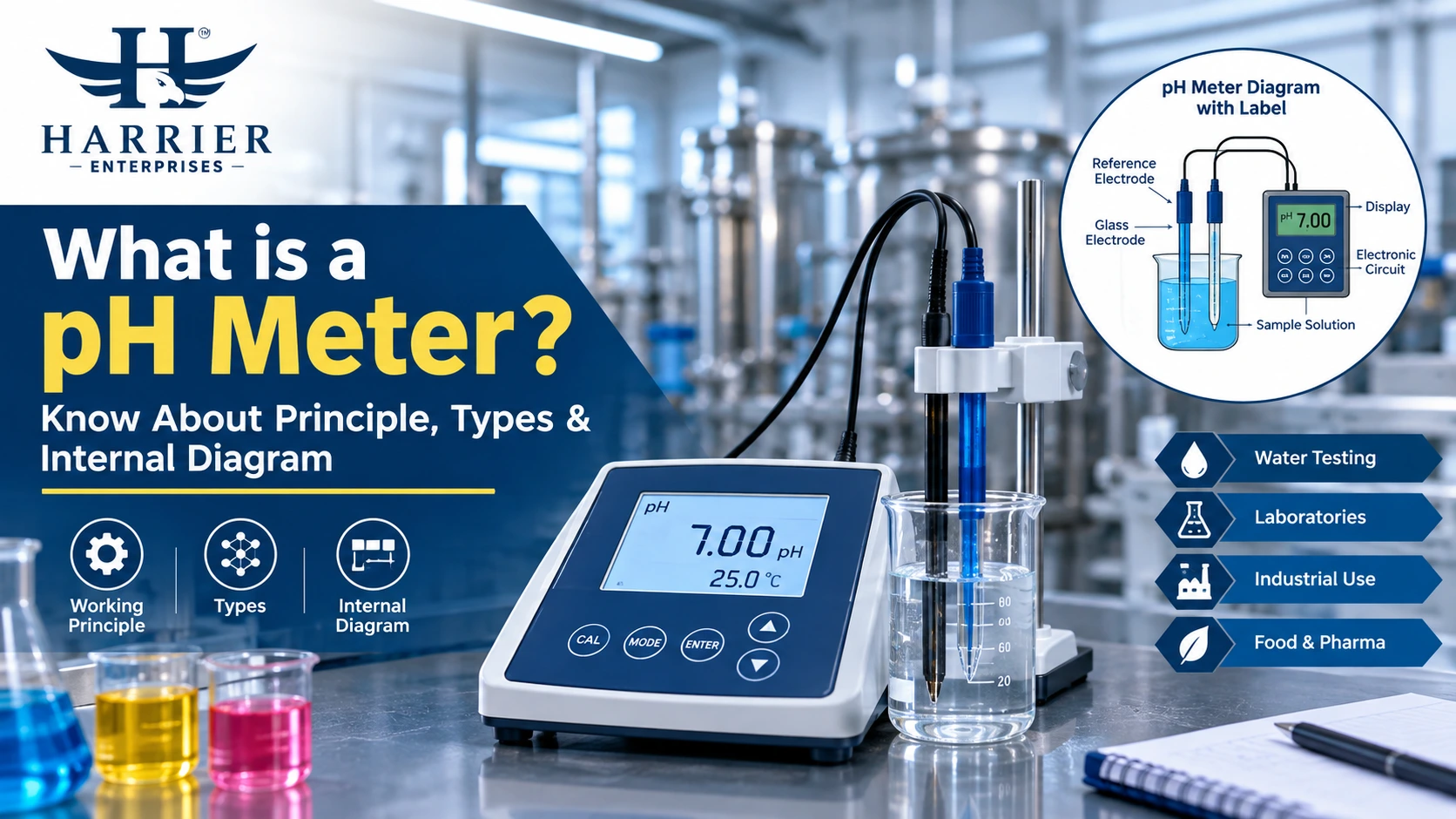
A pH meter is an essential scientific instrument used to measure the acidity or alkalinity of a liquid solution. It provides a numerical pH value, helping users understand the chemical nature and quality of the sample being tested. From laboratories and water treatment plants to food processing and pharmaceutical industries, accurate pH measurement plays a crucial role in maintaining quality and process control. Understanding how a pH meter works, its components, and the underlying principles enables users to obtain reliable and consistent measurement results.
The pH scale typically ranges from 0 to 14; a value below 7 indicates an acidic solution, 7 indicates a neutral solution, and a value above 7 indicates an alkaline solution. A modern pH meter utilizes sensitive electrodes and electronic circuitry to detect hydrogen ion activity within a solution. In this detailed guide, we will explain the principles, various types, internal structure, and labeled diagrams of pH meters using simple and informative language.
What is a PH Meter?
A pH meter is an electronic measuring instrument designed to determine the pH value of liquids, solutions, and other samples. It measures the activity of hydrogen ions present in the sample and converts the electrical response into a readable pH value.
This device is widely used in settings where chemical balance and precise testing are essential. pH meters are commonly employed in water quality testing, chemical laboratories, pharmaceuticals, food production, agriculture, biotechnology, and research centers.
A standard pH meter typically consists of a measuring electrode, a reference electrode, a temperature sensor, an electronic measuring circuit, a display, and a calibration system. These components work together to provide accurate readings.
The basic principle of a pH meter is based on measuring the difference in electrical potential between electrodes. This electrical potential varies according to the concentration of hydrogen ions in the solution.
A simple diagram of a pH meter is useful for anyone learning about the device, as it clearly illustrates how the electrodes, sensing system, internal electronics, and display are interconnected.
Understanding the pH Scale
The pH scale is used to indicate whether a solution is acidic, neutral, or alkaline.
| pH Value | Nature of Solution |
|---|---|
| 0–6.9 | Acidic |
| 7 | Neutral |
| 7.1–14 | Alkaline or Basic |
For example, lemon juice has an acidic pH, while pure water is generally close to neutral. Soap solutions are commonly alkaline. However, the actual value depends on the sample composition and testing conditions.
Accurate measurement is important because even a small pH change can affect chemical reactions, product quality, biological processes, and industrial operations.
pH Meter Principle
The ph meter principle is based on the measurement of electrical potential generated between a glass electrode and a reference electrode. When the electrodes are placed inside a solution, the glass membrane responds to the hydrogen ions present in that solution.
The difference in electrical potential between the measuring electrode and reference electrode is detected by the pH meter. The electronic circuit processes this electrical signal and converts it into a pH value.
In simple terms, the ph meter principle works by detecting hydrogen ion activity and translating the electrode response into a readable number. The higher or lower concentration of hydrogen ions affects the electrical potential.
A properly calibrated instrument is essential because electrode performance can change over time. Temperature can also influence the measurement, which is why many advanced instruments include automatic temperature compensation.
When studying the ph meter principle, it is important to understand that the pH meter does not directly count hydrogen ions. Instead, it measures an electrical response related to hydrogen ion activity.
How Does a pH Meter Work?
The working process of a pH meter begins when the electrode is immersed in the sample solution. The glass electrode develops an electrical potential based on the hydrogen ion activity of the sample.
At the same time, the reference electrode provides a stable electrical potential. The pH meter measures the difference between these two electrical potentials.
The internal electronic circuit receives the signal and processes it using the ph meter principle. The processed value is then displayed as the pH reading.
In advanced instruments, a temperature sensor may also measure the sample temperature. The meter uses temperature compensation to improve measurement accuracy.
A properly prepared ph meter diagram with label can make this working process easier to understand because every major component can be identified clearly.
Main Components of a pH Meter
A pH meter contains several important components that work together for accurate measurement.
1. Glass Electrode
The glass electrode is one of the most important parts of the pH meter. It contains a special glass membrane that is sensitive to hydrogen ions.
When the electrode comes into contact with the sample, the membrane develops an electrical potential. This response changes according to the nature of the solution.
The glass electrode is directly connected to the ph meter principle because it is responsible for detecting changes related to hydrogen ion activity.
2. Reference Electrode
The reference electrode provides a stable and constant electrical potential. It acts as a comparison point for the measuring electrode.
The pH meter calculates the difference between the potential of the glass electrode and the reference electrode.
Many modern instruments use a combination electrode that contains both the glass electrode and reference electrode in one probe.
3. Temperature Sensor
Temperature can influence pH measurements and electrode response. A temperature sensor helps the instrument compensate for temperature-related changes.
This feature is especially useful in laboratories and industrial processes where the sample temperature may vary.
Automatic Temperature Compensation, commonly known as ATC, improves the reliability of measurements.
4. Electronic Measuring Circuit
The electronic circuit receives the weak electrical signal generated by the electrodes. It amplifies and processes the signal according to the ph meter principle.
The circuit converts the electrical response into a pH value that can be understood by the user.
A quality electronic system helps provide stable, fast, and accurate readings.
5. Display Unit
The display unit shows the measured pH value. Digital pH meters may also display temperature, calibration information, electrode status, and other measurement details.
Modern instruments often provide clear digital displays for easy monitoring and recording.
pH Meter Diagram with Label
A ph meter diagram with label is helpful for understanding the basic construction and internal working arrangement of the instrument. The diagram generally identifies the major sensing and electronic components.
A typical ph meter diagram with label may include the glass electrode, reference electrode, temperature sensor, sample solution, electronic amplifier, processing circuit, and display.
The sensing electrode detects the response from the sample, while the reference electrode maintains a stable comparison potential. Both signals are processed by the internal electronic system.
Students, laboratory professionals, and technical users often study a ph meter diagram with label to understand the connection between the electrodes and measuring unit.
A clear ph meter diagram with label also makes troubleshooting, maintenance, calibration, and technical learning easier.
pH Meter Diagram with Labelling
A ph meter diagram with labelling provides a detailed visual representation of the major components involved in pH measurement. Proper labelling helps users understand the role of each part without confusion.
The main labels generally include:
- Glass electrode
- Sensitive glass bulb
- Reference electrode
- Internal electrolyte
- Reference junction
- Sample solution
- Temperature sensor
- Electronic amplifier
- Signal processing unit
- Digital display
A properly designed ph meter diagram with labelling can explain how the electrical signal travels from the electrode to the measuring circuit.
The ph meter diagram with labelling is particularly useful for educational purposes because students can connect theoretical knowledge with the actual instrument structure.
By studying a ph meter diagram with labelling, users can better understand the relationship between electrode response, electrical potential, and final pH measurement.
Internal Construction of a pH Meter
The internal construction of a pH meter includes both mechanical and electronic components. The electrode system is responsible for sensing the sample, while the electronic section processes the signal.
Inside the glass electrode, a special internal solution and internal electrode help create the necessary electrical response. The glass membrane acts as the sensitive interface between the electrode and sample solution.
The reference electrode contains a stable reference system and electrolyte solution. A porous junction allows electrical contact between the reference electrolyte and the sample.
The electronic section includes a high-input-impedance amplifier because the electrical signal generated by the glass electrode is extremely small.
A detailed ph metre diagram helps explain these internal sections and shows how the sensing system communicates with the digital display.
pH Metre Diagram
A ph metre diagram generally represents the complete arrangement of the pH measuring system. It can include both the electrode structure and the main electronic unit.
The electrode section is immersed in the sample, where it detects changes related to hydrogen ion activity. The electrical signal then travels to the measuring circuit.
The internal circuit processes the voltage difference according to the ph meter principle. After processing and calibration, the result is displayed as a pH value.
A technical ph metre diagram may also show the internal electrolyte, glass bulb, reference junction, electrode cable, amplifier, processor, and display.
For laboratory training and technical education, a properly labelled ph metre diagram provides a practical understanding of instrument construction.
Simple pH Meter Diagram
A simple ph meter diagram is an easy representation of the basic pH measurement system. It focuses on the essential components without showing highly complex internal details.
The basic arrangement can be understood as:
Sample Solution → pH Electrode → Electrical Signal → Electronic Circuit → Digital Display
A simple ph meter diagram may also show the glass electrode and reference electrode separately. Both electrodes are placed in the solution, and the potential difference is measured.
The electronic unit receives this information and applies the ph meter principle to calculate the final pH value.
Students and beginners often prefer a simple ph meter diagram because it makes the complete working process easier to understand.
A well-prepared simple ph meter diagram is also useful for presentations, laboratory manuals, educational blogs, and technical training material.
Types of pH Meters
Different types of pH meters are available according to application requirements, measurement accuracy, portability, and operating conditions.
1. Benchtop pH Meter
Benchtop pH meters are commonly used in laboratories. These instruments are designed for accurate and regular testing.
They usually offer advanced calibration options, larger displays, data storage, and temperature compensation features.
Laboratories use these meters for research, chemical testing, pharmaceuticals, and quality control.
2. Portable pH Meter
Portable pH meters are designed for field applications. They are compact and easy to carry.
These instruments are useful for environmental testing, water analysis, agriculture, aquaculture, and outdoor applications.
A portable pH meter allows users to measure samples directly at the testing location.
3. Pocket pH Meter
Pocket pH meters are small and lightweight devices used for quick measurements.
They are commonly used where basic and rapid testing is required.
Although compact, the measurement accuracy and features may vary depending on the model and application.
4. Digital pH Meter
Digital pH meters provide readings on an electronic display. They are widely used because they offer easy reading and convenient operation.
Many digital models include calibration functions and temperature measurement.
Understanding the ph meter principle helps users operate digital instruments correctly and maintain accurate results.
5. Industrial pH Meter
Industrial pH meters are designed for continuous monitoring and process control.
They can be installed in water treatment plants, chemical processing units, manufacturing facilities, and other industrial systems.
These instruments may provide automated monitoring and integration with process control systems.
Applications of pH Meters
pH meters are used across many industries because pH is an important parameter for chemical and biological processes.
Water Treatment
pH measurement is important in drinking water treatment, wastewater treatment, RO systems, and industrial water processing.
The pH value can influence chemical treatment efficiency and overall water quality.
Pharmaceutical Industry
Pharmaceutical manufacturing requires controlled testing conditions. pH measurement helps maintain consistency during formulation and production processes.
Accurate monitoring supports quality control and product reliability.
Food and Beverage Industry
The pH value can affect taste, preservation, fermentation, and product stability.
Food and beverage manufacturers use pH meters during production and quality testing.
Agriculture and Soil Testing
pH measurement is useful for understanding soil conditions and nutrient availability.
Proper soil pH management can support better crop growth and agricultural planning.
Chemical Laboratories
Chemical reactions often depend on controlled pH conditions. Laboratories use pH meters for research, testing, and experimental analysis.
Biotechnology
Biological processes can be highly sensitive to pH changes. Monitoring pH helps maintain suitable conditions for microorganisms and other biological systems.
Importance of Calibration in a pH Meter
Calibration is one of the most important steps before using a pH meter. It ensures that the instrument provides accurate readings.
Standard buffer solutions are used for calibration. Common buffer values include pH 4, pH 7, and pH 10.
The number of calibration points depends on the instrument and application. Multi-point calibration can improve measurement performance across a wider pH range.
Calibration should be performed regularly because electrode performance can change with time and use.
Proper calibration ensures that the ph meter principle is applied accurately by matching the electrode response with known standard values.
Factors That Affect pH Measurement Accuracy
Several factors can influence the accuracy of pH measurements.
Electrode Condition
A damaged, dry, dirty, or aged electrode can produce unstable readings.
The electrode should be cleaned and maintained according to the manufacturer’s instructions.
Temperature
Temperature affects electrode response and measurement conditions.
Using temperature compensation can improve measurement reliability.
Calibration Quality
Expired or contaminated buffer solutions can affect calibration.
Fresh and properly stored buffer solutions should be used.
Sample Contamination
Contaminated samples may provide incorrect results.
Proper sample handling is important for reliable testing.
Improper Storage
pH electrodes should not be stored incorrectly. Proper storage helps maintain electrode performance and extends service life.
Advantages of Using a pH Meter
A pH meter provides several benefits compared to basic indicator methods.
- Provides accurate numerical pH values
- Offers fast and convenient measurement
- Suitable for laboratory and industrial applications
- Helps maintain process quality
- Supports water and chemical analysis
- Available in portable and digital models
- Can include temperature compensation
- Useful for continuous industrial monitoring
- Supports reliable quality control
- Helps improve testing efficiency
The ph meter principle makes the instrument suitable for applications where accurate measurement is more important than a simple visual indication.
How to Use a pH Meter Correctly
To achieve accurate readings, the pH meter should be used carefully.
First, inspect the electrode and make sure it is clean and properly maintained. Then calibrate the instrument using suitable standard buffer solutions.
Rinse the electrode with distilled or deionized water between samples to reduce contamination. Gently remove excess water without damaging the sensitive electrode surface.
Place the electrode in the sample and wait for the reading to stabilize. Record the final pH value only after the instrument provides a stable measurement.
Understanding the ph meter principle, along with the ph meter diagram with label, can help users follow the correct measurement process.
Maintenance Tips for a pH Meter
Regular maintenance improves the accuracy and lifespan of the instrument.
- Keep the electrode clean.
- Calibrate the meter regularly.
- Use fresh buffer solutions.
- Avoid touching the sensitive glass bulb.
- Store the electrode properly.
- Do not allow the electrode to dry when storage instructions require a solution.
- Rinse the electrode between samples.
- Replace damaged or aged electrodes when necessary.
A good understanding of the ph meter diagram with labelling and internal components can also help users identify important parts during maintenance.
Frequently Asked Questions
What is the basic ph meter principle?
The ph meter principle is based on measuring the electrical potential difference between a pH-sensitive glass electrode and a reference electrode. This electrical response is related to the hydrogen ion activity of the sample.
What does a ph meter diagram with label show?
A ph meter diagram with label shows the important parts of the pH measuring system, such as the glass electrode, reference electrode, sample solution, electronic circuit, and display.
Why is a ph meter diagram with labelling important?
A ph meter diagram with labelling helps students and users understand the function and position of each component involved in pH measurement.
What is shown in a ph metre diagram?
A ph metre diagram can show the electrode structure, reference system, electrical signal path, processing circuit, and display unit.
What is a simple ph meter diagram?
A simple ph meter diagram provides an easy overview of the pH measurement process, showing the sample, electrode, electronic circuit, and display.
How often should a pH meter be calibrated?
Calibration frequency depends on the application and usage. For accurate work, regular calibration using appropriate buffer solutions is recommended.
Conclusion
A pH meter is a highly useful and essential instrument for accurately and reliably measuring the acidity or alkalinity of a solution. It operates on the principle of converting the electrical potential difference between a measuring electrode and a reference electrode into a readable pH value. Referring to a labeled diagram of the pH meter makes understanding the device much easier.
Measuring pH is crucial for quality control and process management across a wide range of sectors—from laboratories and research centers to water treatment plants, the food industry, pharmaceuticals, and chemical processing units. Reliable results depend on regular calibration, proper electrode maintenance, and correct usage. Muffle Furnace recognizes the importance of scientific instruments and technical knowledge, helping users understand essential laboratory and industrial equipment through clear, informative, and practical guidance.